At this stop y'all
see one o'
the best changes in
transportation on
this trip!
Interurban Trolley Lines Spread Across North America
It wasn't long after urban street railways were electrified that they became a new franchise. Companies soon started providing frequent, high speed, inexpensive services to take people between cities all over the U.S. and Canada. These inter-city trolleys became known as "Interurban Trolleys."
Early 20th century interurban train which was operated by the Coeur D'Alene & Spokane Railway in the State of Washington. (Postcard from the collection of Rick Russell)
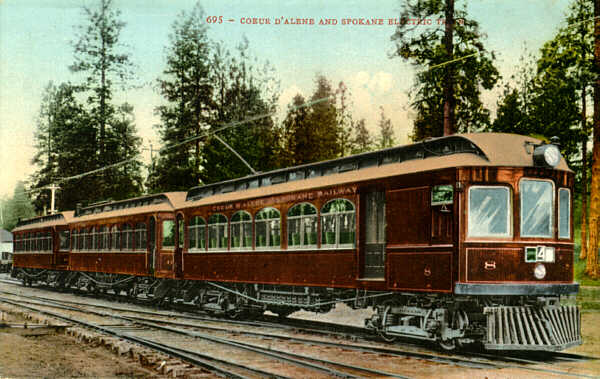
There were five main advantages that Interurban had over steam railroads
*Interurbans were a lot cheaper because they were eco-friendly.
*Because the were eco-friendly they could also travel more frequently.
*Because they had powerful electric motors they could travel a lot faster and maintain a better top speed.
*Also,
because interurban trolleys could make more frequent stops, they
became popular with farmers, and other people who lived in rural
areas.
*They had a better ability to bring people to downtown places.
Interurban
Trolley Lines Also Provided
Freight Service
Many interurban trolley lines supplemented their income from passenger service, by providing car load (CL), and less than car load (LCL) freight and package delivery services. Many merchants and manufacturing companies, depended on the fast, frequent service provided by the interurban trolley lines, to deliver their goods to customers in the cities, towns and rural areas, they served.
Indiana Railroad
trolley freight motor (used to carry LCL freight and packages), hauling
a box car (for car load freight) into the freight station in Muncie,
Indiana (Photo from the collection of Rick Russell)

Big Traffic Problem
Because of their popularity these trolleys made so much traffic so they had to make under-ground trolleys or subways to get around the traffic.
These rapid transit lines, were able to move very large crowds of passengers, quickly from one part of the city to the other, without being delayed by the surface, street traffic. Trolley lines in outlying areas of many of these cities, provided feeder service to the rapid transit lines, which could then bring commuters downtown much more quickly.
